
Have you ever felt “othered”? Like you don’t fit in? Do you feel that you don’t belong? How do you operate and live in such a place, where accommodations make you feel like an outsider?
That’s the conceit of Runaway to the Stars by cartoonist Jay Eaton. Following Talita Dospaço, a hexapodal centaur alien who was raised by humans, she works in a recycling plant junkyard, despite her education in aerospace engineering. Having never felt like she “fit” in with the humans she lives with, yet with no knowledge of her centaur roots, Talita has often felt like an “other;” a square peg in a world filled with round holes. When given the opportunity to learn more about her centaurian background, she must grapple with whether or not to trust an AI ship who might hold the key to understanding that background.
To make the graphic novel a reality, just today Eaton recently launched a Kickstarter through Spike Trotman’s Iron Circus, who has made a name for itself of late for its list of successful crowdfunding campaigns.
I spoke with Jay Eaton recently about the idea behind Runaway to the Stars, the characters we meet in the graphic novel, the research that went into creating the story, and what he hopes readers take from reading the book. Having read a PDF of the graphic novel I can say that it touched me as a person who has felt othered in the past and works with communities that have felt othered. I urge you to give the book and Kickstarter a look!
FreakSugar: Before we get into the graphic novel itself, what is the genesis of Runaway to the Stars?
Jay Eaton: Runaway to the Stars started as a place I could dump all of my science fiction ideas and alien designs into, because at the time I was mostly working on fantasy stories for comics. Then the sci-fi side project mutated into my full-time job and a 300+ page graphic novel. Life’s funny like that.
FS: What is the conceit of Runaway to the Stars?
JE: It’s a hard science fiction story about Talita Dospaço, a hexapodal centaur alien who was raised in human foster care. Now she’s all grown up, 3 meters tall with social anxiety, and a Master’s in aerospace engineering that doesn’t get a lot of use at her job in the recycling plant junkyard on the isolated exoplanet Ixion-3. Her human coworkers find her odd at best and scary at worst, but other centaurs are a mystery to her– they are a rarity in human space, and belong to cultures she isn’t part of.
Then a fancy little ferry vessel shows up at the yard, filled with centaur writing and a marooned ship AI that wants her and her two human friends to fix the ship and get them flying again. But don’t tell anyone else, of course, because Bip the AI used to be a pirate ship and they don’t want to alert the authorities. Talita’s torn between befriending this pretty suspicious AI who knows so much about her estranged species, and her stable career and the trust of her supervisors.
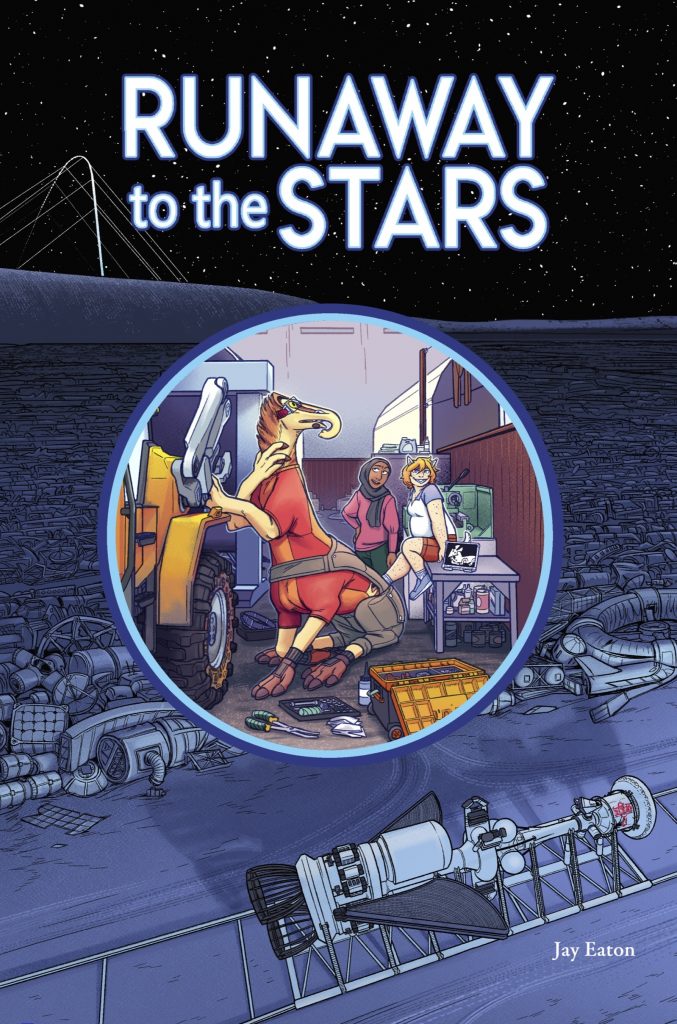
Runaway to the Stars cover
FS: The world of the graphic novel feels fully formed from page 1. What was the process of crafting the world for the characters? Did you have something in mind or did it grow organically?
JE: The setting is something I’ve been developing for over a decade, at first for fun, then now to create entire books. I think it grew together with the characters pretty organically… When designing characters I have to think about how their world shaped them, and while designing the world, I end up thinking about how it could affect the characters and their story. Worldbuilding is part of the story for me.
FS: Speaking of that world, what can you tell us about the cast?
JE: The main cast all have something that alienates them from the people around them, and in that shared loneliness, they find they find connections with each other. Whether they’re a sapient quantum computer on the run from the law, an alien raised by humans, an off-model GMO catgirl with congenital deafness, or a biracial lesbian; they know what it’s like to struggle to communicate with other people and find community.
FS: The press release for the graphic novel notes how Runaway to the Stars is for folks who have felt othered, unheard, or displaced. My fiancée is a speech-language pathologist and we’re both teachers, so it was very nice to see this kind of attention put on representation and being seen. Was this idea always at the forefront? What has the process been like developing the cast and how they interact?
JE: I think those themes arose very naturally out of the setting, particularly around disability. A shared living space with aliens is fundamentally an accommodation problem, because it’s a group of people with different needs and abilities. I also wanted to portray a science fiction setting where disability has not been eradicated by science, because frankly I don’t think that’s possible. Disability exists relative to what level of ability is expected by society, and society is always changing. A person with dyslexia and a severe corn allergy is not disabled in prehistoric Europe, but they are disabled modern North America. A person resistant to gene therapy in modern North America is probably going to live a normal life, but in a society of people living in microgravity who get gene therapy to tolerate the negative side effects, they would have a disability. Likewise, Talita is a healthy adult centaur alien, but because she lives in a majority human society, she needs special accommodations for her diet, size, and body.
FS: Following up on that, did you have to do any research about communication for the graphic novel?
JE: Quite a bit. Obviously, I did research when putting together the alien languages but the big one was regular human sign language. Since those languages actually exist, are used by marginalized communities, and tend to be poorly understood or misrepresented in popular culture, I wanted to do the best I possibly could in depicting it. The Jovian characters in the book speak in modern American English (non-diegetically, would be over 300 years of language shift behind Jovian English, but that would make dialog rough to parse as a reader), so I decided to mirror this by depicting the signing as (also not wholly diegetic) modern American Sign Language. This involved in-person classes, researching Deaf history and culture, and consulting with people in the Deaf community about specific things in the comic. I still have lots to learn.
FS: It’s a very uncertain time for the world right now, especially in the United States. There are so many othered communities and at-risk people who are afraid and suffering. I believe that, when we feel helpless, we can look to the arts and create art on our own. Does working on your comic work do that for you? And what do you hope readers take away from your art?
JE: Yeah, I think so. Runaway to the Stars is a story about a medley of different societies each with their own problems, but WW3 is in the past, and humans and aliens are working together peacefully to build a future of cooperation and prosperity. I don’t think society is ever going to stop having conflicts; there is no “end state” of culture where humans (or hypothetical aliens) achieve utopia. But granular progress towards better welfare for all people and the planetary ecosystem we are part of is always worth fighting for.
FS: On to the Kickstarter itself, Iron Circus has made a name for several successful campaigns of late. How did this partnership arise with the company?
JE: The founder Spike actually reached out to me while I was still in college, because she liked the worldbuilding art I was posting on my blog. I couldn’t propose a book to the company then of course because I was trying to not fail my classes, but after graduation I finally put together a packet for Runaway to the Stars. I’m thankful they took a chance on me as a first-time author, since keeping an art blog for fun and creating a graphic novel involve drastically different levels of commitment.
FS: If you had a final pitch for the Kickstarter and graphic novel, what would it be?
JE: Augh. I’m not good at summarizing things, I do much better at adding an unnecessary amount of detail to everything. But I think that if you love creature design, worldbuilding, rocket science, unlikely friendships, or all of the above, Runaway to the Stars is worth a look!
The Kickstarter for Runaway to the Stars is now LIVE! This book is so much fun and very poignant for readers young and old who have ever felt othered or like they don’t “fit.” Be sure to sure to check out the campaign for yourself!
From the official press release for the graphic novel and Kickstarter:
Iron Circus — the premiere publisher of award-winning, critically-acclaimed graphic novels in the American Midwest, which has raised nearly 5 million dollars via crowdfunding — is proud to announce its latest campaign for RUNAWAY TO THE STARS, a hard sci-fi slice-of-life graphic novel from cartoonist Jay Eaton that will immerse readers in a universe at once intriguingly alien and painfully familiar. The main storyline follows Talita, a centaur aerospace engineer and cross-species foster kid, as she befriends a shipwrecked AI pirate named Bip who convinces Talita to help it escape the planet of Dirtball. Focused on communication, accommodation, and everyday life in co-species spaces, the intricate and meticulously built world of RUNAWAY TO THE STARS will travel to readers on this planet via Kickstarter this spring. Sign up to be notified when the campaign officially launches.
Abandoned as an infant on the doorstep of the Nexus Jovia youth foster care facility in a cat carrier, centaur and aerospace engineer Talita has no idea where she came from. She’s spent the vast majority of her life around humans, has very little familiarity with her own species’ cultures, and has always had trouble connecting with anyone — other than sentient AI beings, that is. So when Talita discovers a damaged Centaur spaceship in the Ixion Recycling Plant’s salvage yard with a pirate AI onboard named Bip, she quickly becomes drawn into its plans to escape the planet of Dirtball. But her two human friends, Idrisah and Gillie, aren’t about to let her commit crimes on behalf of a shady AI… not without their help, of course! Because Bip, the pilot of the Runaway, is definitely not telling Talita everything about what happened to the ship’s now-deceased centaur crew, or what mission they might have been on. But despite Bip’s suspiciously shady past, the AI is a charmer and quickly gets the team on board to help. Now all they have to do is secretly repair the ship and get all the clearances needed to file a flight plan… Of course, they just can’t get caught doing it.
“This story is for everyone who’s ever felt displaced, othered, or unheard — and every reader that loves a good sci-fi story and is intrigued by what secrets a sentient pirate AI might be hiding,” said Iron Circus Publisher C. Spike Trotman. “One of the (many) things that makes RUNAWAY TO THE STARS so great is Jay’s attention to the complexities of communication. We have Gillie, a genetically-modified human who is Deaf, forced to deal with clunky and ineffective tech in her efforts to communicate; Idrisah, a professional xenolinguist who can communicate with double-larynxed alien Avians, but can’t fluently speak in either of her family’s languages; and Talita, whose social anxiety and fear of inconveniencing others gets her taken advantage of, despite her towering height and fearsome appearance. This singular graphic novel is a testament to the fact that our all-too-human faults and anxieties are universal concerns — no matter your point of origin!”
RUNAWAY TO THE STARS’ intricately-built primary story is supplemented with immersive appendices and overflowing with additional context. The campaign will also feature extras such as an exclusive bookplate and a discounted bundle of Iron Circus titles hand-picked by cartoonist Jay Eaton.
To support the campaign for RUNAWAY TO THE STARS, head to Kickstarter: https://www.kickstarter.com/projects/ironspike/runaway-to-the-stars?ref=afkj6x
For updates, follow Iron Circus Comics on X, Facebook, Bluesky, and Instagram.