
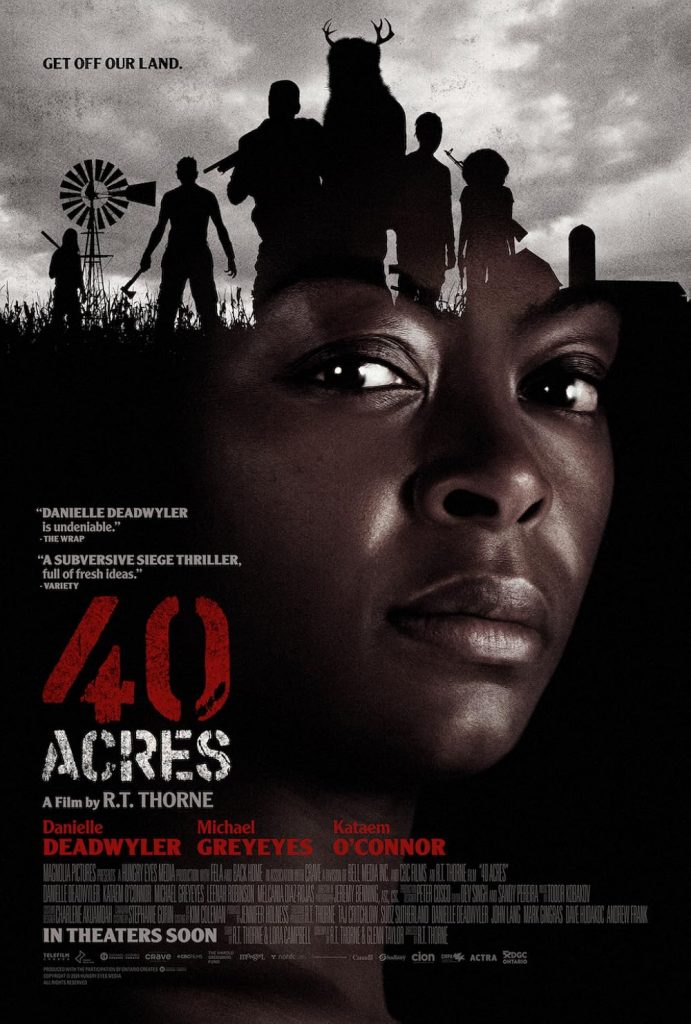
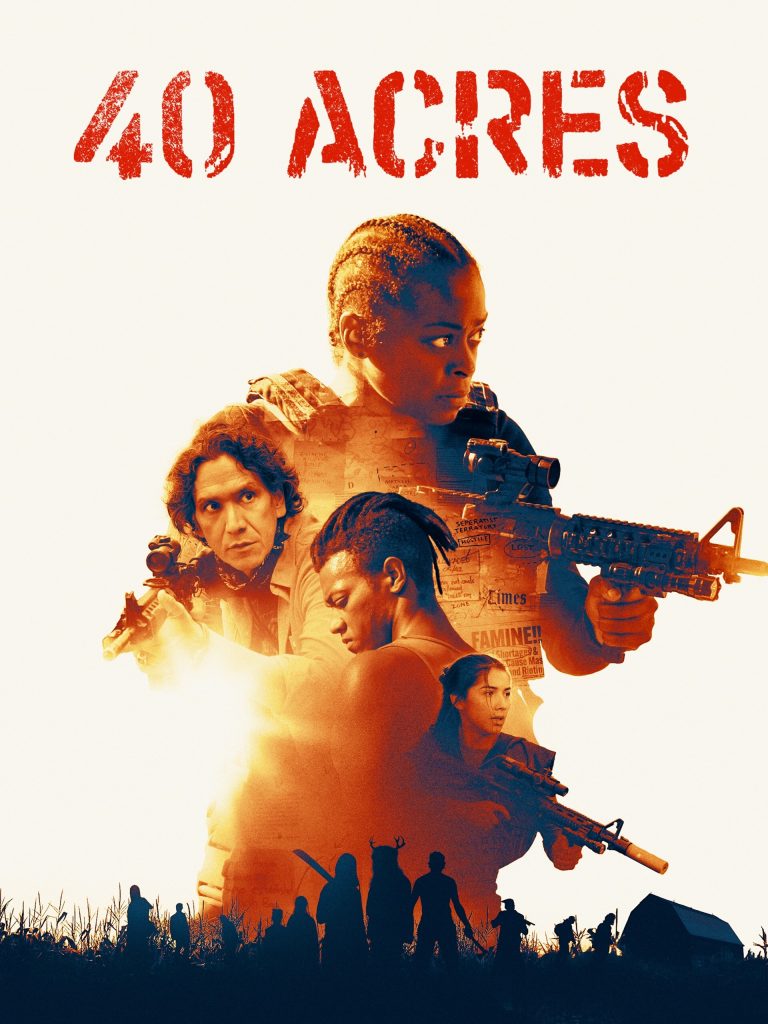
In the grand tradition of post-apocalyptic films, writer and director R. T. Thorne presents 40 Acres, now on Blu-ray, DVD, and OnDemand from Magnolia Home Entertainment. In 40 Acres, the Freemans, led by matriarch Hailey (portrayed by Danielle Deadwyler) are trying to survive in a future ravaged my wars and pestilence. Descendants of African American farmers who settled in Canada after the first Civil War, the family are doing well farming the land, despite the odd raiding party attempting to disturb their peace. However, one of the Freeman children will let loneliness overcome him, putting the group at risk.
I spoke with R.T. Thorne recently about the conceit of 40 Acres, the family we follow in the film, some of his favorite apocalyptic tales, and what he hopes people take away from watching the film.
Editor’s note: This interview was conducted a few months ago. Due to technical issues, we had trouble getting the interview to post. Now that has been resolved, we are publishing the interview in full.
FreakSugar: As a history teacher, the story idea for 40 Acres had me hooked immediately. Can you tell us about the genesis of the film?
R.T. Thorne: I grew up in the Midwest of Canada, near Calgary, Alberta. My father worked in the produce industry, so the connection between people and caretaking of land has always kind of resonated with me my whole life. So, when I decided to tell a survival story about a Black family that wasn’t set in the past, I still wanted it to be connected to our history, and it became very apparent to me that the story had to be one that was centered around land. The denial of land to Black families throughout history is tied to that broken promise, so it was important to reference it, and pay tribute to the many that persevered and fought for land rights, as well as those who made great journeys for the opportunity to claim what they deserved. There are so many families that traveled through the Underground Railroad for land legacy and that became the story of the Freemans in this film, as detailed by Hailey (Danielle Deadwyler) to her son, Manny (Kataem O’Connor), of where their family got their land from and why it’s so important to her.
And if I’m going to make a film about defending land, no other peoples understand more about fighting for land rights than the indigenous peoples of North America. It seemed important to have an Indigenous presence in the mix because the reality is that we’re all visitors to their native lands. So, I wanted to pay tribute to the long history of connection, camaraderie and cooperation between Indigenous peoples and people of African descent which many people don’t know about because it’s so scarcely shown or spoken about in the history books and less on film (except for old westerns where were all victims of villains). I thought it would be interesting to see a family made up of these two cultures united in defense of the land that they have, and project them into this dark future, but not as victims, rather as the most resilient people in the film. They’re the ones that are best equipped to deal with the future. So, it was about sort of flipping the historical tragedy of the past, into a future narrative that is a story of triumph and community.
FS: What can you tell us about the family we follow in the film?
RTT: I wanted to see a family where each of the members regardless of age or gender, could legitimately defend themselves if need be. If we’re talking about true survival, it’s an adherence to a philosophy of doing whatever it takes to self-sustain so yes that includes weapons and physical training but also medical and agricultural practices. There has to be a sense of agrarian and older traditional & cultural knowledge because you don’t have access to modern technology to ensure you can work land to produce food, so their cultural history was very important to how they survive. They are a blended family, Black and Indigenous, two cultures that have suffered greatly through colonialism but as a result, are well equipped to survive in the future because of their ancestral knowledge.
Once you get past the survivalist layer, they’re like most other families they get on each other’s nerves, they take the piss out of each other, and they have very differing points of views, especially Hailey and Manny, about how the family should live. They’re unified in their fight for survival, but they’re not unified in their ideology, and that conflict is the main tension of the film. It serves as a great engine to power the film because as the danger rises around them, their chances of surviving really comes down to whether mother and son are going to come to an understanding about how to move forward. I love character driven thrillers so rooting the conflict within the family, it made our thriller much more personal.
FS: The movie feels so tightly told. How did you keep that contained feeling? What did it add to the story and production for you?
RTT: It was always designed to be a thriller that would be told completely from the family’s POV, so I wanted to place the audience in the family’s isolated shoes. In their world of mass hunger, people will literally do anything to eat so danger is around every corner, information is scarce, rumors are abound, paranoia runs wild, and so that that feeling of tension is palpable. It was something that I wanted to permeate every scene both narratively and visually, so we were constantly looking to trap the characters in spaces that would limit what they could see like the basement, the barn, tall corn fields, heavy fog and night time in the fields, to literally shutting the lights out on the audience in the house. All of these were ways to visually represent that idea of placing the audience in the mindset of an isolated, paranoid family that always has to be vigilant and alert.
FS: Do you have any favorite dystopian stories?
RTT: There are so many stories in the genre that I love. Referenced in the film of course is Octavia’s Parable of the Sower, that I read at a young age and stayed with me. The Stand as well. In cinema Blade Runner, The Matrix were foundational for me, Blood Quantum from the great Jeff Barnaby, Spielberg’s War of the Worlds, Book of Eli, It Comes at Night, Mad Max and an amazing HBO series called Station 11 all left their mark.
FS: Besides being entertained, what do you hope viewers take away from the movie?
RTT: My main goal was always to make a film that was grounded in the real psychological fight for survival, rooted in family, but that could be fun and a good time. Sometimes post-apocalyptic and other genres like action or horror can be nihilistic, but I always think even in dark stories there’s room for conversations about family, humanity and community. I hope that people walk away from the film feeling like they were on a fun ride but that it stays with them, and gives them something to reflect on.
FS: If you had a final pitch for 40 Acres, what would it be?
RTT: If you’re looking for a good movie night get ready for a kick ass post-apocalyptic thriller about survival, family and community, with tension, heart, and a standout performance from Danielle Deadwyler, and family you won’t forget, check out 40 Acres out now on Blu Ray, DVD and digital rental everywhere.