

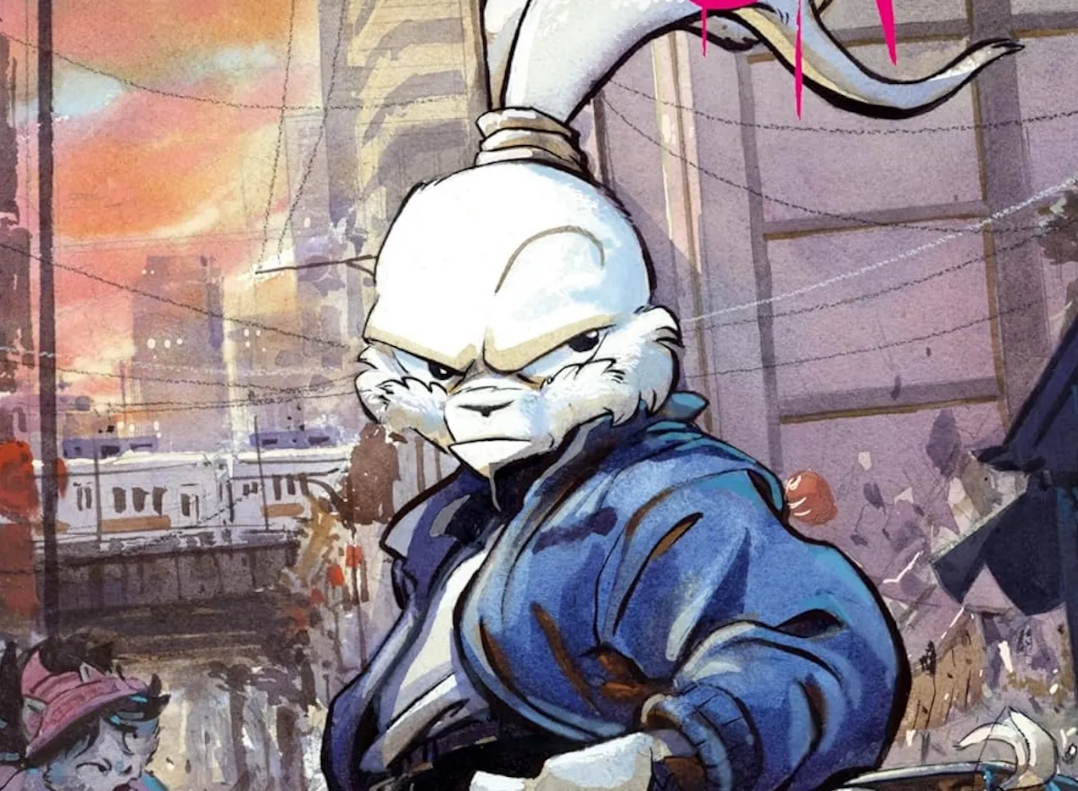
The rabbit rōnin known as Usagi Yojimbo has been an adventuring force for good in comics and on screen for over 40 years. First appearing in Albedo Anthropomorphics, Usagi Yojimbo was brought to life by cartoonist and comic book creator Stan Sakai, who has taken Usagi on a whole host of scrapes and battles for publishers from Fantagraphics Book to IDW Publishing and, of course, Dark Horse Comics. However, the rōnin’s latest romp for Dark Horse focuses not on Usagi, but his descendent. In Usagi Yojimbo: Kaitō ’84 from Dark Horse and Dogu Publishing, the eponymous protagonist Kaitō focuses his attention on the welfare of the people of 1984 Osaka and, most importantly, his nephew Yukichi. From the creative team of writer Zack Rosenberg and artist Jared Cullum with Stan Sakai as creative director, Kaitō ’84 feels right at home in the Usagi Yojimbo mythology while still being its own unique story.
I spoke with Jared Cullum and Zack Rosenberg recently about the story behind the making of Usagi Yojimbo: Kaitō ’84, their history with the character of Usagi Yojimbo, working with Stan Sakai and the Dogu team, what we can expect to see in the series, and what working on the comic means to them.
There’s a reason that Usagi Yojimbo has been such a beloved character for over four decades: The character is so dynamic and brimming with fun, sure. But what makes every Usagi-related tale simply sing is the creative teams behind those stories. The interview you are about to read was conducted via email, but the passion that Jared Cullum and Zack Rosenberg have for Usagi Yojimbo and Usagi Yojimbo: Kaitō ’84 radiates off the screen. The first three issues are already on sale, with two more to go, and it’s consistently been one of the first comics I tackle on my to-read list each month. What they come with next will be just as special; not a prediction, just a fact.
FreakSugar: Before we get into the comic itself, what is your personal history with the world of Usagi Yojimbo?
Jared Cullum: I did not read a lot of comics when I was very young. I came to the world of Usagi Yojimbo through the TMNT animated series on television. From the first appearance I was completely hooked on the character. I was immediately hooked and dying to know more about the character. It was probably 1992 or so and my parents bought me the Usagi Yojimbo TMNT action figure that TMNT produced, back when almost all action figures looked like “He-Man.” I carried that little muscle-bound version of Usagi literally everywhere in my pocket. I would fill notebooks with little comics of Usagi Yojimbo. I couldn’t draw very well, so they were mostly just stick figures with either bandanas or bunny ears but I was totally hooked.
I came to comics later in life and that’s when I started collecting the sagas. It never occurred to me that I would eventually meet Stan Sakai but he emailed me out of the blue because we were both up for a Rueben award and we have built a friendship since then.
Zack Rosenberg: It really all starts with my dad. He was the “origin story” for my love of comics; he bought me my very first Usagi issue (shoutout to Pee Wee Comics in Agoura Hills, CA), and honestly, the rest is history. He nurtured that passion from day one, and I wouldn’t be the writer or creator I am today without that early spark he provided.
On the geekier side of things, I’ve had the incredible luck of attending comic conventions consistently for over 25 years. I actually have a personal sketchbook with an Usagi sketch Stan drew for me back in 2002 or 2003. At the time, I was just a 13-year-old kid in awe of his work. If you had told that younger version of me – or even Stan himself – that we’d eventually be collaborating on a series together, neither of us would have believed it. It’s a literal dream come true.

FS: What was the genesis of Usagi Yojimbo: Kaitō ’84? How did this take on the mythos evolve into this story?
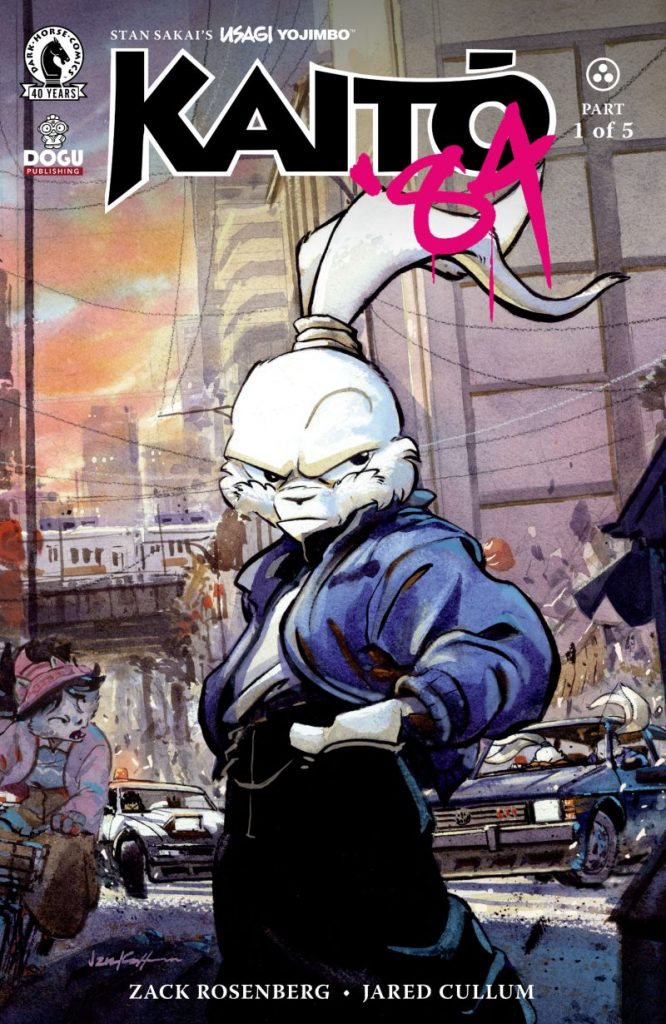
JC: For general practice, I’m pretty heavily involved in “plein air” or outdoor painting events. I had traveled to do this outdoor painting event in a small town in Pennsylvania. Just sitting on the street was a little yellow car I was immediately obsessed with. It had so much character and interesting shapes. I painted it immediately and then later, out of curiosity, googled what it was and it turned out to be a 1984 VW Rabbit. At the time there was a lot of chatter online about the 40th anniversary of Usagi Yojimbo so I did some little scratch doodles of various anthropomorphic characters from UY that would possibly drive that car and sent them to Zack. I had a lot of environment and character ideas but no story. Zack sat down and in about a day had a complete story together he sent to me. We refined the concept together and it evolved into the mini-series.
ZR: Honestly, it started with Jared and I just being massive fans. We’ve been friends for over a decade, and I remember exactly where I was when he told me he was doing variant covers for Stan about five years ago. My immediate reaction was: “can we pitch them a story?!” Jared, being the ever voice of reason, stayed professional and said “no – I literally just got the job!”
Fast forward a few years. Jared completely gobsmacked me by sending over a sketch he did for fun; a 1980s-inspired version of Usagi. The second I saw that design, I told him “Give me 24 hours to write a pitch.”
When we finally brought that pitch to Stan and the Dogu team, we were hyper-aware of the weight of what we were doing. There is a specific kind of cold-pitch pressure when you are presenting a creator with a new version of their own life’s work. We knew we had to respect the core that makes Usagi legendary while proving that this 1984 descendant had a reason to exist. That awareness influenced everything – from how we handled the lineage to the specific type of 80’s flavor we introduced. We wanted Stan to see that we weren’t just playing with his toys; we were taking care of them. Thankfully, he saw that vision, and the rest is history.
FS: For folks considering picking up the comic, what is the conceit and setup of where we find the cast at the beginning of Kaitō ’84?
JC: I can talk about the environment and maybe Zack can talk about the characters themselves. The setting is in 1984 in Osaka, Japan. The country had seen a massive boom in its economy. Like every country it had its own history of gangs and corruption and we both liked the idea of a sort of robin-hood-type figure that came
out of Osaka. In initial concept sketches he was carrying the sword from the original and a cooler version of the members only jacket. We both felt like it was too much like starting a video game with all the cool stuff and wanted the reader to experience starting from ground zero. So, the lineage, the sword and friendships are all something we get to earn with this offspring who is presented with his legendary past and asked, by circumstance, if he wants to follow in this warrior’s pilgrimage or give up and go back to his normal life.
ZR: When we first meet Kaitō, he is at a major crossroads in his life. While he is very much his own rabbit, with his own modern struggles, he carries some of those unmistakable traits of his legendary ancestor.
This first inaugural story is designed to push him onto a path he’s not entirely sure he’s ready for. He’s navigating the gritty, neon-soaked reality of 1980s Japan, trying to figure out what it means to be a ronin in a world that deprioritizes honor. We wanted to start him in a place where his heritage and his future are in direct conflict, forcing him to decide exactly what kind of hero he wants to be.
To Jared’s point above, we are not meeting these characters at the very beginning of their journeys. Kaitō is already a known entity throughout Osaka. We really wanted to drop the reader into a world that felt lived-in and established.
FS: How would you describe Kaitō? He very clearly connects to Usagi’s legacy while being his wholly own person.
JC: We extensively discussed what a “warrior’s path” would look like in the modern era. How those principles would reflect on current day life and technology. One key difference is that we meet Kaito-Usagi and Yukichi at a slightly younger age and having been raised in a time that is much more comfortable than the Edo period in Japan. They have cars and manga for example and have not fought in a hand-to-hand combat war. With their age and softer upbringing, we felt like the characters would have a different toolbox of emotions we could tap into. So, their range of expression is different, although their honesty and adherence to a code of something bigger than themselves remains.
ZR: Can I say I just like Jared’s answer? Haha. But to piggy back a little off what Jared was saying, while Kaitō shares the core DNA and honorable spirit of Usagi, he is operating in a much more complicated world. A big part of the journey in this series for him personally is the realization that his impulsive way of doing things might not be the most effective way to apply himself. He’s learning–often the hard way–that being a hero in a modern age requires a different kind of discipline. He’s a bit of a work in progress, and that’s what makes him so fun to write.
FS: Following up on that, the reader instantly understands who Kaitō is within the first few pages: devil-may-care while being good what he does. Besides the Usagi tradition, did you have any other characters in mind when creating him?
JC: We talked about a lot of characters when we were discussing building out the story. A lot of film and animated film research went into what they could be like and what their world would feel like. The two biggest influences that jump out immediately are Ghibli films in general and ‘Monkey Punch’s as well as Miyazaki’s directing work on Lupin III.
ZR: To echo Jared: he’s a modern-day Robin Hood with all the charm of Monkey Punch’s Lupin III, dropped right into the middle of a lush, hand-painted Ghibli landscape.

FS: Kaitō and Yu’s friendship is very sweet and endearing and also feels very lived-in from the jump. How would you describe their relationship?
JC: They’re cousins and it’s not directly related to their specific relationship, but one of the things that drove my drawing of expressions and feelings was being a father. As your kids grow and become more independent, the love and biological need to protect them remains even though they become their own person and start to leave your arms reach. At a certain point, they become their own person and make their own decisions. So, I wanted to have the flashback in the first issue to show how Kaitō has put himself in the role of protector and leader and is coming to an age where he’s beginning to question whether or not he made the right decisions in doing so.
ZR: I feel Kaitō’s dynamic with Yu is where his true layers start to show. To me, outside of being cousins, they have a bit of a “Frodo and Samwise” energy – a deep, foundational bond that grounds Kaitō’s flashier instincts. It’s a relationship both Jared and myself are incredibly excited to explore, hopefully in the next arc!
FS: The action is incredibly kinetic and very readable, especially the opening sequence. Throughout the book, there’s this marriage of pop and grit that is simply perfect. What are the conversations like about how the book should look?
JC: There is a lot of back and forth on layout design and I tend to write completely in storyboards where Zack writes in outlines and can convert to scripts. So, part of the process, for me, is creating storyboards like an animated film of what I’m seeing happen in my head and then we work together to translate that to comic panels.
A lot of grit probably comes from the spontaneous haphazard nature of watercolor. You have to embrace that it’s going to largely do what it wants to and work with that. Any resistance or too much control makes overworked watercolors.
ZR: I cannot tell you how much I appreciate you saying that about the visual storytelling. To address the elephant in the room – Jared is a comic writer’s dream, a true gift. Working with him makes the entire creative process a total joy. To give you a peek behind the curtain, our collaboration is a bit of a hybrid “Marvel Method.” Once we’ve mapped out the overall arc we want to tell, we tackle the story issue by issue, page by page, beat by beat. It’s a very rhythmic process.
Once our beats for a specific issue are locked in, Jared takes the lead and storyboards the entire thing. Seeing his initial layouts is always a highlight for me because he has such an intuitive sense of movement, like you are reading something that is honest to go moving. Once his layouts are handed off to me, I translate them to a full script with a first pass on dialogue. Then, we spend time refining both the visual storytelling and the words together, polishing every panel until we feel we have that perfect page for a reader to soak up.
FS: The “Letter to the Readers” at the end of issue #1 mentions being blessed with Stan Sakai’s wisdom, editor Justin Eisinger, and the Dogu team. What is the collaboration like with all of you? How have those conversations informed your story?
JC: Initially we were extremely nervous talking to any of the Dogu team. I kept thinking I was going to put my foot in my mouth or get us fired for not being good enough. Turns out- they are the nicest people in comics and it’s an absolute joy talking to any of them. Stan is the last stop for green-lighting before anything goes to final. The general process is we go off and work on stuff and then send it in for suggestions or ideas to our editor Justin. Justin will often present or send stuff to the Dogu team for feedback or next steps toward approval. Each of the team has been integral with insights and thoughts.
ZR: It is incredibly collaborative and encouraging. I wish I had more to say but it’s just that great. Nuff said!
FS: Following up on that, the comic feels very cinematic. What are some of your influences for the book, film or otherwise?
JC: I learned a lot of what I know about framing and composing panels from watching Kurosawa films. Long before I ever dreamed of doing anything related to Usagi Yojimbo. I have just loved Seven Samarai, Yojimbo, Stray Dogs and probably most influential on this story was “Ikiru.”
Apart from that Tampopo, the film, had a lot of influence on clothing and world building, particularly the food people eat.
ZR: Jared and I took it upon ourselves to dive deep into a massive amount of 80s Japanese cinema. I share the same inspiration he noted above. But beyond live action cinema, we talked a lot about what Studio Ghibli does so well: the “quiet moments.” In Ghibli films, there are these beats of stillness – just a character walking or soaking in their surroundings – or in Yu’s case, eating – that serve the story by grounding it in reality. We wanted Kaitō ’84 to have that same sense of breath. By focusing on those small, authentic details, I think it gives the book a unique texture that feels more like a film than a standard comic.
It’s that balance of high-octane action and those grounded, quiet beats that we hope makes the world feel real and immersive for readers.
FS: Can you tease what we might see in the comic going forward?
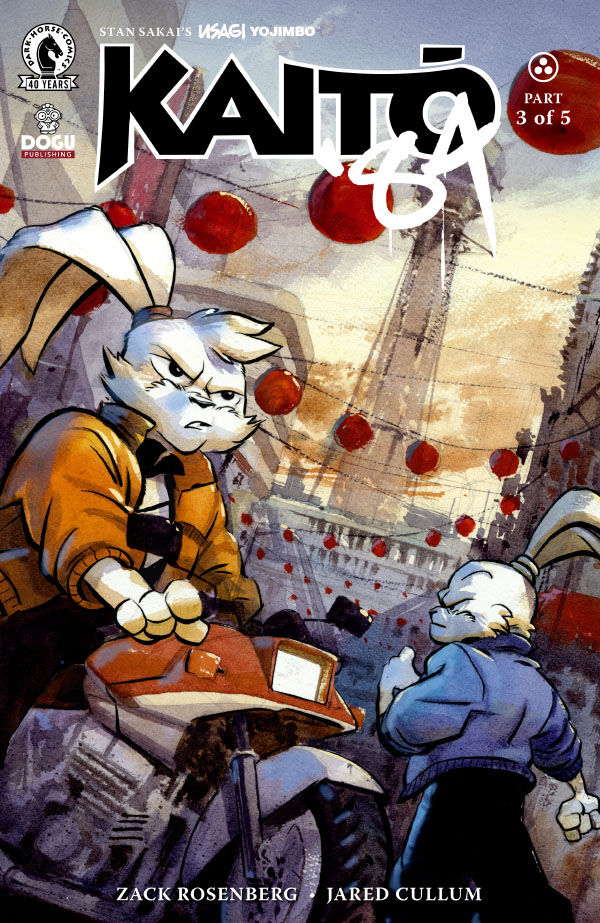
JC: Going forward from issue #1 is where the story starts to unfold and become more ambitious in the scope of the world they live in. We got to play a lot with world-building in this environment and beyond. In the second book we are introduced to the classical Yojimbo character, Sasuke. If you’ve ever read a Usagi Yojimbo where Sasuke walks into frame then you know things are about to get crazy. So, we had a lot of fun with that and further focusing on building the relationship between the characters.
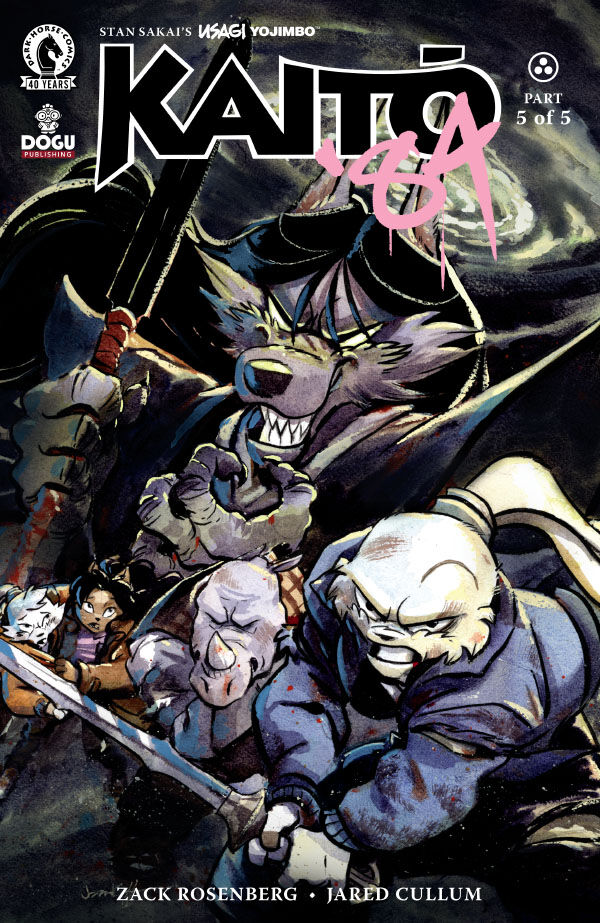
ZR: Issue #1 was just us clearing our throats; the true scale of this world begins to explode from here. Because we’re working with a monthly 20-page limit, Jared and I have to be incredibly meticulous with our storytelling real estate. Every single panel is intentional. If you look closely, our inner cinema geeks and Usagi fanboys have already started planting seeds—whether it’s subtle foreshadowing or a cheeky easter egg—that are going to pay off for both old and new fans in fun ways.
FS: If you had a final pitch for Kaitō ‘84, what would it be?
JC: When we worked out the idea we were very ambitious in the scope of what we wanted to do. We were writing some very large creative checks that we weren’t totally sure we had the balance to fulfill. At its core, we hope you get a sense of the fullness of the environment. My dream is that as you read you can hear the cars and feel the wind and taste the food. That beyond reading a story we put a lot of passion and hope into, you will viscerally experience living in this world and connecting with these iterations of Stan’s characters.
ZR: Who are you?! Honestly, these are some of the most sincerely thoughtful and amazing questions I’ve ever received.
I think Jared really hit the nail on the head regarding the atmospheric side of things, which I believe is what makes our book such a unique entry in the Usagi universe.
At a high level, our ultimate hope is that this book serves as both a faithful continuation for long–time readers and a perfect entry point for brand new fans. The biggest compliment you could possibly give us is if Kaitō ‘84 inspires you to pick up the original Usagi Yojimbo books and experience 40 years of truly exceptional storytelling. To be honest, I’m already jealous of the folks who get to make that leap and experience Stan’s masterwork for the very first time.
Kaitō ’84 #1-3 are on sale now from Dark Horse Comics. Issue #4 goes on sale Wednesday, June 24, 2026.
From the official description of issue #4:
Forced into an impossible alliance, Kaitō and Tomoe now face the ultimate test. To escape a sacred shrine, they must overcome three ancient trials designed to push their courage, intellect, and compassion to the absolute limit. With monstrous guardians and spectral demons at every turn, their only hope for survival is each other. But is a partnership between a thief and a cop strong enough to endure a final test designed to break them apart?